Putin envoy warns of Russian economy going 'berserk' on war footing
By Gleb Bryanski
MOSCOW, Sept 1 (Reuters) - The Russian economy runs a risk of going "berserk" if it is run to focus entirely on the needs of the military-industrial complex, President Vladimir Putin's international development envoy was quoted as saying on Tuesday.
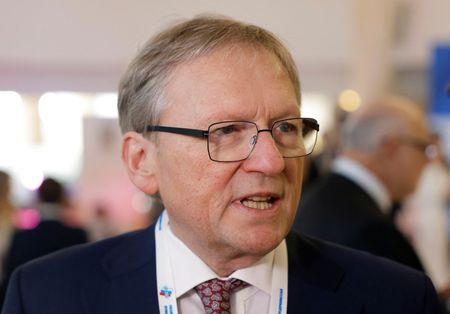
The comments by Boris Titov to business news outlet RBC were a rare sign of concern in Kremlin circles about the increasing pressure on the slowing economy to secure a victory in the 4-1/2-year war in Ukraine.
Titov, appointed in 2024 as Putin's special representative to international organisations for achieving sustainable development goals, is a wealthy businessman who used to own Russia's leading producer of sparkling wine. He led an influential business lobby and ran for president in 2018.
"Military and civilian economies have always existed in symbiosis everywhere. Many technical inventions that are useful for all originated within the military-industrial complex. The key lies in maintaining balance," Titov told RBC.
Russia has hiked taxes, embarked on property redistribution, welcomed contributions from businesses to finance the war, and, most recently, threatened business owners who are not doing enough to protect their facilities from Ukrainian drones.
War hawks and some government officials often refer to the reorganisation of the Soviet economy under dictator Josef Stalin during World War Two as a model, citing the wartime slogan "Everything for the front, everything for victory".
'BERSERK' MODE IS TIME-LIMITED, TITOV SAYS
This approach is met with cautious but growing resistance from various sectors.
"This is not an economy at all, it's a kind of 'berserk mode' that can only exist for a very limited time, and the necessity of which should be considered very carefully," Titov said on the eve of a major economic forum that Putin will attend this week in Russia's Far East.
RBC, which conducted the interview, noted that the term berserk derived from mythological Norse warriors who entered a trance-like state, possibly drug-induced, that enabled them to fight ferociously and ignore pain.
The Russian economy is expected to grow at only 0.4% this year, and many non-military sectors are stagnating or shrinking. Ukrainian attacks on economic targets such as refineries, online retailers and oil and grain export infrastructure may push this growth rate even lower.
Titov's comments echo a statement by Moscow's technocrat mayor Sergei Sobyanin, who argued last month that "killing a normal economy is equivalent to killing the whole country".
Andrei Klepach, the chief economist at the state development bank, lost his job last month after highlighting the economic challenges posed by the war in a public speech.
Russia will hold a parliamentary election this month, from which the only political party calling openly for an end to the war had been barred. Opinion polls show growing fatigue from the war and support for a peace settlement.
Such sentiment is being exacerbated by persistent rumours of a large-scale post-election military mobilisation for a final push to seize the whole of the Donbas region of Ukraine. The Kremlin has called such rumours a hoax.
(Reporting by Gleb Bryanski; Editing by Mark Trevelyan and Alison Williams)
Find it fast
Looking for more insights? Explore our other news sections for updates on sustainable finance, companies and financial education