Dollar hits new 40-year high versus yen, euro softer after ECB stands pat on rates
By Chuck Mikolajczak
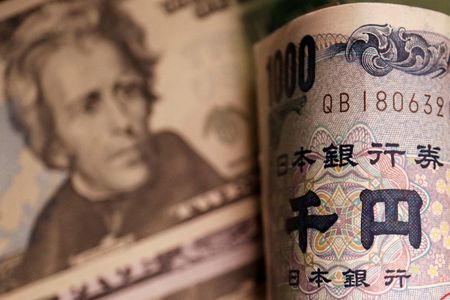
NEW YORK, July 23 (Reuters) - The dollar strengthened to a fresh 40-year high against the yen and climbed against the euro on Thursday as oil prices continued to shoot higher on rising hostilities in the Middle East, while the European Central Bank kept interest rates unchanged.
Oil prices rose for a fifth straight day, with Brent touching the $100 a barrel mark for the first time since May 26, as U.S. President Donald Trump promised "major military punishment" for Iran and its Houthi allies, after the Yemeni fighters struck two Saudi oil tankers in the Red Sea, spreading the Middle East war to a second major shipping chokepoint.
The dollar has been rising in recent days as renewed strikes in the U.S.-Iran conflict have caused a reversal in oil prices and again fanned inflation fears, in turn buoying expectations the Federal Reserve may hike interest rates.
The U.S. economy is seen as more insulated from energy price shocks compared with Europe and Japan, which has also supported the dollar.
The dollar index, which measures the greenback against a basket of currencies, rose 0.36% to 101.47, with the euro down 0.33% at $1.1372. The dollar was on track for its biggest daily percentage gain in a month.
U.S. crude jumped 6.81% to $92.75 a barrel and Brent surged to $101.21 per barrel, up 7.59% on the day.
ECB HOLDS RATES STEADY
The ECB kept interest rates unchanged as expected but held the door open to another increase in September, as a fresh jump in energy prices threatens to keep inflation well above its 2% target. President Christine Lagarde said "while developments in underlying inflation have remained contained, the full effects of the energy shock have yet to play out".
"(Lagarde) said the risks of a weakened economy are high and the risks of higher inflation are high, but given that, they're not raising rates, so of course, the dollar's continuing to strengthen," said Joseph Trevisani, senior analyst at FXStreet in New York.
"So what are we pricing in here — are we pricing in higher prices in oil, which you've already seen, or are we pricing in the possibility of disruption, which does exist? Anytime there's an active shooting war, things are not very predictable."
Markets are now pricing in a 71% chance of a rate hike from the ECB at its September meeting, according to LSEG data.
Analysts at Morgan Stanly said in a note that a hike from the central bank would be positive for the euro, as markets are not pricing in a deep enough restriction to hurt the currency, and would not be high enough to restrict growth.
The recent rebound in oil prices, along with comments from multiple Fed officials, including Chair Kevin Warsh, that have flagged concerns about inflation pressures over labor market concerns, have helped push market expectations for rate hikes from the central bank higher.
MARKETS PRICE IN SEPTEMBER MOVE
U.S. data on Thursday showed weekly initial jobless claims dropped by 22,000 to a seasonally adjusted 187,000, according to the Labor Department, the largest decline in three months and well below the 212,000 estimate of economists polled by Reuters.
Markets are currently pricing in a 35.8% chance for a rate hike of at least 25 basis points at the Fed's policy meeting next week, up from 11.8% a week ago, according to CME FedWatch. For the September meeting, expectations for a hike have climbed to 81.4%, up from 52.4% a week ago.
The Japanese yen weakened 0.41% against the greenback to 163.79 per dollar after touching 163.98, its softest level since November 1986, with expectations of a more deliberate approach to rate hikes at the Bank of Japan compared with its global counterparts. Markets are pricing in about 25 basis points of hikes from the central bank this year, according to LSEG data.
However, Japan's 2-year government bond yield hit a 31-year high on Thursday on growing bets that the BOJ would accelerate the pace of interest rate hikes.
Akira Otani, senior Japan research economic adviser at Goldman Sachs, said in a note that they believe the BOJ "will maintain the status quo at the July meeting, and continue to expect the next rate hike in January next year," but caution the timing of hikes is "likely to be significantly influenced by market developments and the degree of progress in communication with the government."
Japan's finance minister reiterated the government was prepared to take decisive action on foreign exchange as needed, after carrying out yen-buying operations in April and May, with the yen weakening beyond the 160 level.
(Reporting by Stefano Rebaudo; additional reporting by Satoshi Sugiyama; Editing by Thomas Derpinghaus, Hugh Lawson, Emelia Sithole-Matarise and Deepa Babington)
Find it fast
Looking for more insights? Explore our other news sections for updates on sustainable finance, companies and financial education