-
Markeder
athexgroup.grAthens Exchange GroupLes merTogether for a unified, stronger European capital market.
-
Aksjer
Sustainable finance2025 Euronext ESG Trends ReportLes merA data-driven snapshot of how Euronext-listed companies are advancing their Environmental, Social and Governance (ESG) practices.
-
Indekser
Access the white paperInvesting in the future of Europe with innovative indicesLes merThe first edition of the Euronext Index Outlook series with a particular focus on the European Strategic Autonomy Index.
-
ETF-er
The European market place for ETFsEuronext ETF EuropeLes merInvestors benefit from a centralised market place that will not only bring transparency but also better pricing due to the grouping of liquidity.
- Fond
-
Obligasjoner
European Defence BondsGroupe BPCE lists the first bondLes merFirst financial institution in Europe to issue a bond dedicated to the defence sector
- Strukturerte produkter
-
Derivater
Where European Government Bonds Meet the FutureFixed Income derivativesLes merTrade mini bond futures on main European government bonds
-
Råvarer
- Oversikt
- Agricultural quotes
- Power Derivatives
- Milling Wheat derivatives
- Corn derivatives
- Spread contracts
- Rapeseed derivatives
- Durum Wheat derivatives
- Salmon derivatives
- Container Freight Futures
- Levering og oppgjør
- Spesifikasjoner og ordninger
- Commitments of Traders (CoT) report
- Commodity brokers
Building a sustainable and liquid power derivatives market.Euronext Nord Pool Power FuturesLes merEuronext and Nord Pool, the European power exchange, announced the launch of a dedicated Nordic and Baltic power futures market.
-
Ressurser
Designed to help students navigate the complexities of financial marketsEuronext Trading gameLes merJoin the Euronext Trading Game and step into capital markets. Learn from today’s leaders, explore sustainable opportunities, and trade with confidence.
Germany could gain from planned U.S. port fees on China-built ships, DIW says
By Rene Wagner and Maria Martinez
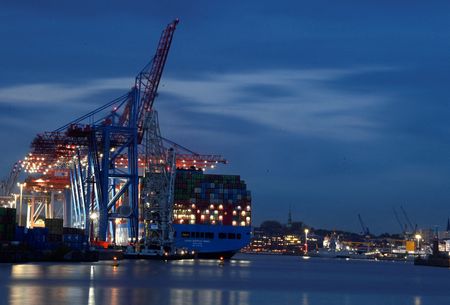
BERLIN, July 8 (Reuters) - Germany could benefit from planned U.S. port fees on merchant ships built in China, with its exports to the United States potentially rising by around 2% compared with a scenario without fees, according to a study by the German Institute for Economic Research (DIW) seen by Reuters on Wednesday.
The reason is that German freight fleets rely less on Chinese-built vessels than those of some competitors, allowing German exporters to gain market share, the study found.
The U.S. government plans to introduce the fees from November in an effort to curb China's dominance in shipbuilding, citing national security concerns. The charges would be based on where a vessel was built, rather than whose goods it carries.
DIW said the measures would primarily hurt the U.S. itself, estimating that U.S. imports and exports would fall by 0.2% and 0.3%, respectively.
"The mechanism is simple," DIW economist Sonali Chowdhry said. "The fees raise the cost of intermediate inputs, U.S. manufacturers lose competitiveness, and weaker economic activity also weighs on demand for foreign goods."
Within the EU, Finland, Denmark and Poland would be hit hardest, with exports to the U.S. falling by 5.0%, 4.4% and 3.0%, respectively.
Emerging economies such as Costa Rica, Vietnam and Pakistan could see U.S.-bound exports slump by nearly 9%, while South Korea could gain about 2%.
(Reporting by Rene Wagner and Maria MartinezEditing by Linda Pasquini)
Find it fast
Looking for more insights? Explore our other news sections for updates on sustainable finance, companies and financial education