EU governments can use some defence fiscal leeway for green energy, Commission says
By Jan Strupczewski
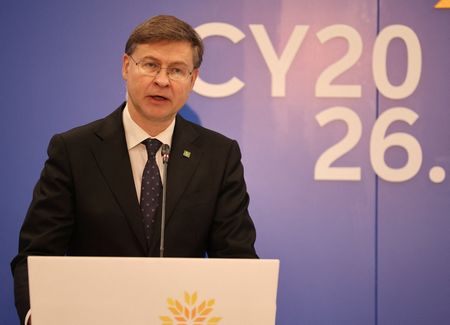
BRUSSELS, June 3 (Reuters) - The European Commission will allow EU governments to use some of the fiscal leeway already granted for higher defence spending, to pay for moving away from fossil fuels to green energy, European Economic Commissioner Valdis Dombrovskis said.
The move is a response to pressure from Italy, which faces elections next year, to soften EU fiscal rules to support voters facing rising energy bills because of the U.S.-Israeli war on Iran that choked off oil and gas through the Strait of Hormuz.
Normally, EU governments have to keep budget deficits below 3% of GDP to comply with EU fiscal rules.
But Russia's invasion of Ukraine and the threat Moscow now presents to the EU, made the Commission rule in March 2025 that every EU country to spend an extra 1.5% of GDP each year for four years on defence without getting into trouble.
Unlike Finland, the Baltic countries or Poland, which share a history of Russian occupation, Italy sees the Russian threat as remote and rather than on defence equipment it wants to focus on easing the pain of more expensive energy for Italian voters.
Rome has been therefore pushing strongly for the Commission to allow fiscal leeway for EU governments to spend on cushioning the effects of the more expensive energy, even though few other EU countries shared the view such leeway is needed.
As a compromise, the Commission, which has been calling for governments to heed the price signal of more expensive energy and reduce rather than subsidise consumption, decided to allow EU countries to use 0.3% of GDP, out of the 1.5% of GDP of extra leeway already allowed for defence, to pay for investment that would help the transition from fossil fuels to green energy.
Dombrovskis said 0.3% of GDP per year in 2026, 2027 or 2028, but not more than 0.6% of GDP over the three years in total, would be allowed, to support, for example, the purchase of electric vehicles, changing heating systems from oil and gas to heat pumps, the installation of solar panels, or batteries.
But he made clear the leeway could not be used to subsidise fossil fuel prices, like the Italian decision to slash the excise tax on petrol. "Those kind of initiatives are not eligible," Dombrovskis said of tax cuts.
Those countries which decide to make use of the extra fiscal room allowed by the Commission for green energy can deduct measures implemented since February, Dombrovskis said.
For those EU countries that have already used all their extra fiscal space of 1.5% of GDP on defence investment, like Lithuania and Estonia, they can still apply to the Commission for the extra 0.3% of GDP and get it after a debt sustainability analysis, he said.
(Reporting by Jan Strupczewski)
Find it fast
Looking for more insights? Explore our other news sections for updates on sustainable finance, companies and financial education