Italy blames German gas storage delays for price spike
By Francesca Landini
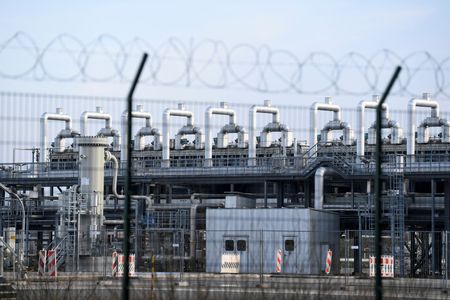
MILAN, Oct 29 (Reuters) - Germany has let Europe down by delaying filling its gas stocks for too long in an effort to reduce costs for its companies ahead of their privatisation, an Italian energy official said on Thursday, blaming Berlin for the latest gas price spike.
Benchmark European front-month gas prices touched €100 ($111.5) per megawatt hour on Wednesday for the first time since December 2022, putting governments under pressure from consumers and opening a debate over what measures can be used without distorting the European market.
The Italian government has been lobbying the European Commission for months for the green light to use public funds to cut gas and power costs for households and companies.
Speaking at the Montel Italian Energy Day conference in Milan, the Italian Energy Ministry's Director General for Energy Markets and Infrastructure, Alessandro Noce, said Rome had spent hundreds of millions of euros to fill its gas storage ahead of winter.
Germany has delayed stockbuilding while focusing on the privatisation of its energy groups Uniper and SEFE, key players in the storage-filling process, an energy analyst said speaking at the same conference.
"Hearing that a European country chose not to fill its storage facilities because it wanted to privatise a company is alarming to me," Noce said.
"We are getting hit twice: we paid €300 million to fill the storage facilities, and we are paying more for gas because the Germans are buying it now... this is something that really makes me angry," he added.
Germany's regulatory body said on Thursday that the country's gas storage was 61.7% full. Italy's storage was almost 91% full and the EU average stood at about 75%, according to Gas Infrastructure Europe.
In written comments to Reuters, Germany's Economy Ministry said that gas supplies were secure for the coming winter despite storage levels falling well short of the legally required targets for November 1. Germany was expected to get through the winter without supply shortages, the ministry said.
The government had taken additional precautionary measures, including extra gas injections and tenders to secure supplies later in the winter. Some of these measures would only take effect after November 1, it said.
The ministry also confirmed plans to replace mandatory storage filling targets with a national strategic gas reserve.
Noce said he expected that the benchmark gas contract could reach between €150 and €180 per MWh in the event of a cold January.
"It depends on the weather. We have to root for global warming and hope that January is warm," Noce said.
Should January be as cold as last year, especially in Poland, Lithuania and northern Germany, there will be problems, he added.
($1 = 0.8971 euros)
(Additional reporting by Kirsti Kolle, Holger Hansen in Berlin; Editing by Kirsten Donovan and Alistair Bell)
Find it fast
Looking for more insights? Explore our other news sections for updates on sustainable finance, companies and financial education