Hungary to cut deficit below 5% of GDP in Magyar's first budget plan
By Gergely Szakacs and Marc Jones
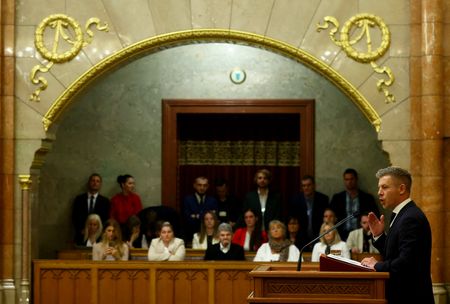
BUDAPEST/LONDON, Oct 19 (Reuters) - Hungary's budget will target a much lower deficit of 4.9% of gross domestic product in 2027, Prime Minister Peter Magyar said on Monday as he unveiled the government's draft plan, seen as a credibility test for its ambitions to adopt the euro.
Magyar's government inherited an estimated 7.5% of GDP budget shortfall from former prime minister Viktor Orban this year, and its plan is more ambitious than a 5.3% deficit expected by analysts in a Reuters poll last week.
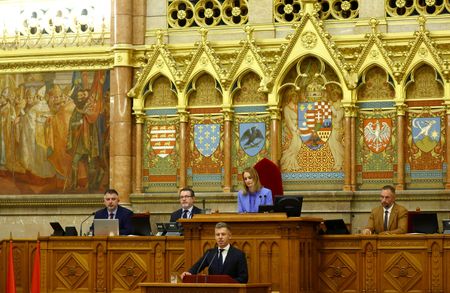
"We need only look around Europe to understand the scale of its significance and what is at stake," Magyar told parliament in a speech presenting the 2027 budget that lasted more than two hours.
"The examples of France or Romania show exactly where it leads when a government is unable to curb overspending, corruption and theft for years," he said. The budget will include a 300 billion forint (826 million euro) contingency reserve.
The announcement of the deficit target sent the forint, central Europe's best-performing currency this year, to four-week highs versus the euro.
Magyar and his government are aiming to narrow the deficit to below the EU's 3% target ceiling by 2030 while still honouring their pledges to voters that helped secure his landslide election win over Orban in April.
Magyar said he would use billions of euros of European Union funds released after the rollback of Orban-era reforms seen as harming democracy to launch large-scale investments in housing, infrastructure and water management to mitigate climate change.
"The 4.9% deficit target appears somewhat better than market expectations going into the announcement, although the key question now is delivery," said Yvette Babb, a fund manager at William Blair.
MAGYAR ADDS MORE THAN $6.2 BILLION OF NEW SPENDING
New spending is set to reach more than 2 trillion forints ($6.2 billion) next year, including 449 billion in pension increases, 677 billion in public sector wage hikes, a doubling of the family allowance and tax cuts for more than 2 million people on lower incomes.
Magyar said the phase-out of Orban's pre-election largesse and one-off spending would improve the budget balance by 1.4 percentage points. A wealth tax and tax rises on large companies would add 1 percentage point of revenue, he said.
Cutting back on corruption and public sector overspending would save 1.5 percentage points of output, with lower debt-servicing costs trimming another 0.1 to 0.2 point, he said, bringing the overall fiscal balance improvement to 4 percentage points.
Magyar said he would use 1.4 percentage points of that leeway to deliver on election promises, while the remaining 2.6 points would be used to curb the deficit.
The government will launch a 200 billion forint wealth tax, increase taxes on energy companies by 100 billion forints and raise the corporate tax by 2 percentage points to 11% for companies with annual turnover over €500 million.
Spending to ease the burden of energy price spikes on households, a costly Orban-era measure, which the EU has called on Hungary to eliminate, will remain in place.
The government's aim to adopt the euro has triggered a rally in Hungary's forint, which helped drive inflation below the central bank's target, while bond yields have tumbled this year and are among the lowest in central Europe.
Analysts see Hungary joining the euro in 2032 or 2033.
(1 euro = 363.0084 forints)
(Reporting by Gergely Szakacs and Marc Jones; Writing by Jason Hovet; Editing by Hugh Lawson)
Find it fast
Looking for more insights? Explore our other news sections for updates on sustainable finance, companies and financial education