Short-seller puts spotlight back on Raiffeisen's ties to Russia
By Alexandra Schwarz-Goerlich, Linda Pasquini and John O'Donnell
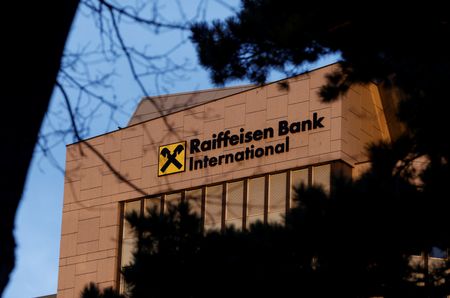
VIENNA, Sept 17 (Reuters) - Austria's Raiffeisen Bank International (RBI) is facing renewed scrutiny as the biggest Western bank still operating in Russia, after a short-seller alleged it was a key channel enabling more than $1 billion of Russian trade to circumvent sanctions.
On Thursday, Raiffeisen said the report published by Grizzly Research was misleading and contained factual errors.
Raiffeisen's bank in Russia is the biggest lender in the country not subject to sanctions which have isolated local rivals, meaning it has become crucial for trade payments, including gas exports to Europe.
Grizzly Research claimed the bank had become a "key channel" for getting around Western sanctions on Russia, involving trade of more than $1 billion and including some goods used in Russian weapons.
"We stand by the strength of our compliance systems, which have been reviewed many times," Raiffeisen said on Thursday.
The bank has said it has been trying for years to leave Russia, making a number of failed attempts to sell up. It has reduced but never closed its business there.
In 2024, U.S. authorities warned RBI that it could be prevented from accessing U.S. dollars on account of its dealings with Russia, but never carried out the threat.
Grizzly said it had a short position on RBI's stock, which allows it to profit from a falling share price. The bank's shares fell as much as 9%.
FINANCIAL LINCHPIN IN AUSTRIA
With sprawling industrial holdings, more than 18 million customers from Vienna to Moscow and 44,000 staff, Raiffeisen is a financial linchpin for Austria and much of eastern Europe.
Russia had become an even bigger money spinner for the bank in the aftermath of the war with Ukraine, although it has been stopped by Moscow from taking the billions of euros in profits out of the country.
Raiffeisen has made several attempts to sell its Russian arm to a local buyer in the hope that Moscow would lift the bar on repatriating the windfall profits.
Russian officials, however, have opposed the sale in a desire, sources have said, to maintain what remains of its economic ties with Europe, which still buys billions of euros of Russian oil and gas, albeit far less than before the war.
(Reporting by Linda Pasquini, additional reporting by Alexandra Schwarz-Goerlich, editing by Thomas Seythal, Kirsten Donovan, Elaine Hardcastle)
Find it fast
Looking for more insights? Explore our other news sections for updates on sustainable finance, companies and financial education